


Interview anxiety can lower a candidate’s interview score. Yet one study found that it had almost no relationship with how that person later performed on the job (International Journal of Selection and Assessment).
That should concern anyone who hires people.
In a controlled study involving 823 participants with management experience, candidates gave identical, scripted answers to the same questions. Those who displayed more anxious nonverbal behavior received substantially lower ratings and were perceived as less competent. Their qualifications and answers had not changed (Journal of Personnel Psychology).
The interviewers were not evaluating different evidence. They were reacting differently to the same evidence.
An interviewer cannot watch a candidate lead a difficult team, challenge a flawed strategy, or handle a crisis. Those abilities must be inferred from a conversation.
Calmness becomes competence. A polished answer becomes strategic thinking. Immediate rapport becomes “cultural fit.” Nervousness becomes a lack of executive presence. However, candidates should not have to manufacture charisma to prove they can do the work.
Are companies hiring the best person for the job, or the person who is best at being interviewed?
Improving Interview Methods
The better alternative is not eliminating interviews. It is replacing informal conversations with structured interviews and direct evidence of ability. In a structured interview, every candidate receives the same job-related questions and is evaluated using predetermined criteria. Research places structured interviews among the stronger methods for predicting job performance, along with job-knowledge and work-sample tests (Cambridge University Press).
Employers should also let candidates demonstrate the work. If the job requires someone to analyze, write, sell, prioritize, or lead through conflict, give the candidate a short and realistic exercise.
The assignment should not require hours of unpaid labor or ask candidates to solve an active company problem. It should provide a fair opportunity to show how they think.
What Can Candidates Do, Then?
Candidates cannot redesign the hiring process, but they can work through their stress response and replace ambiguity with undeniable evidence.
Reducing Interview Stress
Practice this daily for several days, not for the first time outside the interview.
- Sit with both feet on the floor.
- Inhale gently for four seconds.
- Exhale slowly for six seconds.
- Continue for three minutes without forcing unusually deep breaths.
- Immediately answer “Tell me about yourself” aloud.
The longer exhale helps slow the physical stress response. Answering a question immediately afterward connects that calmer state with interview performance. Research reviews have found that regulated breathing can reduce anxiety.
When a question is asked, do not be afraid to pause, and if you need to buy time, say, "let me think about that for a moment.." A brief pause will not damage the interview. Rambling for three minutes because you answered too quickly might. Breathe and collect your thoughts, then answer. You'll be less stressed because you've given yourself a moment to think and be confident in how you will respond, you slowed down and took a minute to breathe.
Produce Undeniable Evidence
“The best example is when I inherited a struggling team and brought the project back on schedule within four months.”
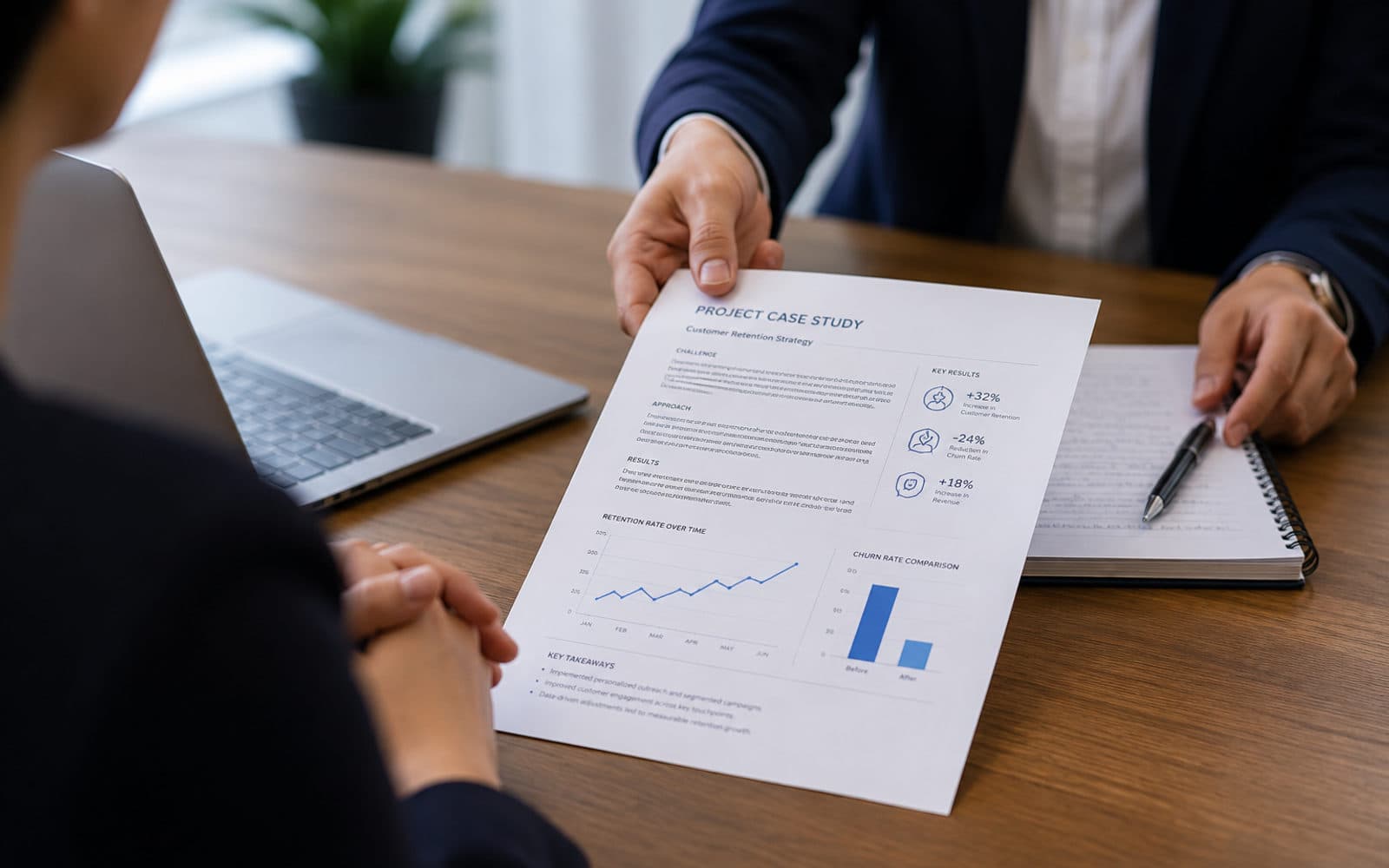
Put your evidence front and center making it crystal clear for the interviewer. Consider bringing a short, sanitized example of your work, a one-page case
study, a sample analysis or a thought leadership piece. Just be careful about how and when you introduce it: "I took the liberty of bringing a sample of the type of analysis that you need. Let me know if you'd like to review it."
Avoid lengthy narrative, buried results, vague descriptions of your contribution, and a rapid speaking pace that will increase your nervousness. You may not be able to fully eliminate your anxiety, but you can work on preventing anxiety from hiding your ability.
Before the interview ends, ask:
“Is there anything you have heard today that leaves you uncertain about my ability to succeed in this role?”
Conclusion
This is not about becoming more charismatic or pretending not to be nervous. It is about making sure anxiety, personality, or an interviewer’s initial reaction does not obscure what you can actually do.
Unless interviewing is the job, employers should be asking a different question. Candidates should help them answer it.